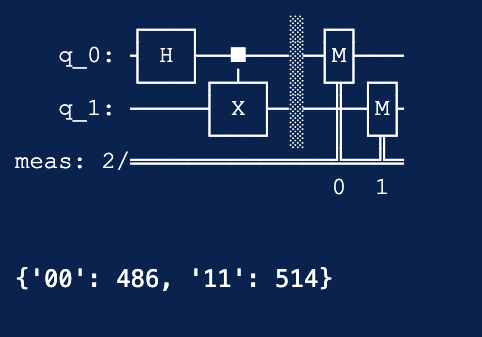
When performing sampling with IBM's quantum computing library Qiskit:
RND_SEED = 1

from qiskit.circuit import QuantumCircuit
from qiskit_aer import AerSimulator
from qiskit_ibm_runtime import SamplerV2 as Sampler

# Generate a quantum circuit.
qc = QuantumCircuit(2)
qc.h(0)
qc.cx(0, 1)
qc.measure_all()
display(qc.draw())

# Measure the quantum circuit
sim = AerSimulator()
sampler = Sampler(mode=sim, options={
    "simulator": {"seed_simulator": RND_SEED}
})
result = sampler.run([qc], shots=1000).result()
print(result[0].data.meas.get_counts())
# example OUTPUT: {'11': 489, '00': 511}
By fixing the random seed for observation, the same results can be obtained for each run. For instance, when setting RUN_SEED = 1, the output is consistently {'00': 491, '11': 509}, meaning the quantum states '00' and '11' are observed 491 and 509 times, respectively.
However, if the seed is set to 0, as in RND_SEED = 0, the seed is no longer fixed, and the observation results vary with each execution of the run method.
Package Versions
- Qiskit: 1.3.1
- Qiskit Aer: 0.15.1
- Qiskit IBM Runtime: 0.34.0